Challenge
On-premises infrastructure deployment automation is hard!!!
The process of getting the infrastructure ready for end-user consumption often stretches over months, which seems like an eternity for enterprises that are exposed to the agility of public clouds.
Let us see how enterprises deal with their on-premises infrastructure today.
If an end user wants to deploy a new revenue-generating application or service, they submit a ticket to their server team for access to the desired infrastructure. The server team, using a variety of tools, try their best to prepare the servers, but they must rely on the network team to provision the necessary underlay fabric, which introduces delays.
If storage is also required for the application, another ticket must be raised for a separate team, further prolonging the deployment process. The storage team, in turn, depends on the network team for IP, DNS, and firewall configurations. All this, while the network team is always short-staffed and burdened with manual configuration or bespoke scripting of leaf-spine-border switches so that the end-user can communicate with the servers and applications, can be made accessible to their consumers.
Each stage introduces multiple wait periods, resulting in a lengthy on-premises infrastructure deployment timeline and an unsatisfied end user. Adding to the complexity, most of the on-prem deployments are heterogeneous in nature, which constitute multiple technologies and multiple vendors' equipment.
Productive hours are lost in coordinating the activities among different groups, and not to forget the revenue loss because of the delayed rollout of new application or features.
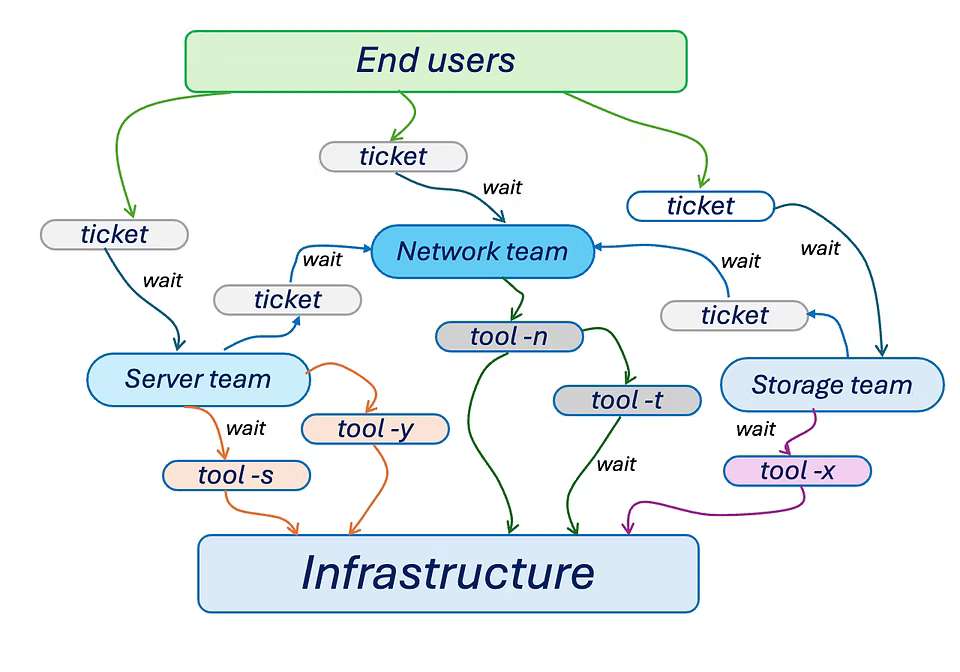
To address this complex spaghetti of infrastructure deployment and to achieve cloud-like agility in on-premises environments, innovative solutions are needed.
Solution
Let's explore how MetalSoft simplifies this problem.
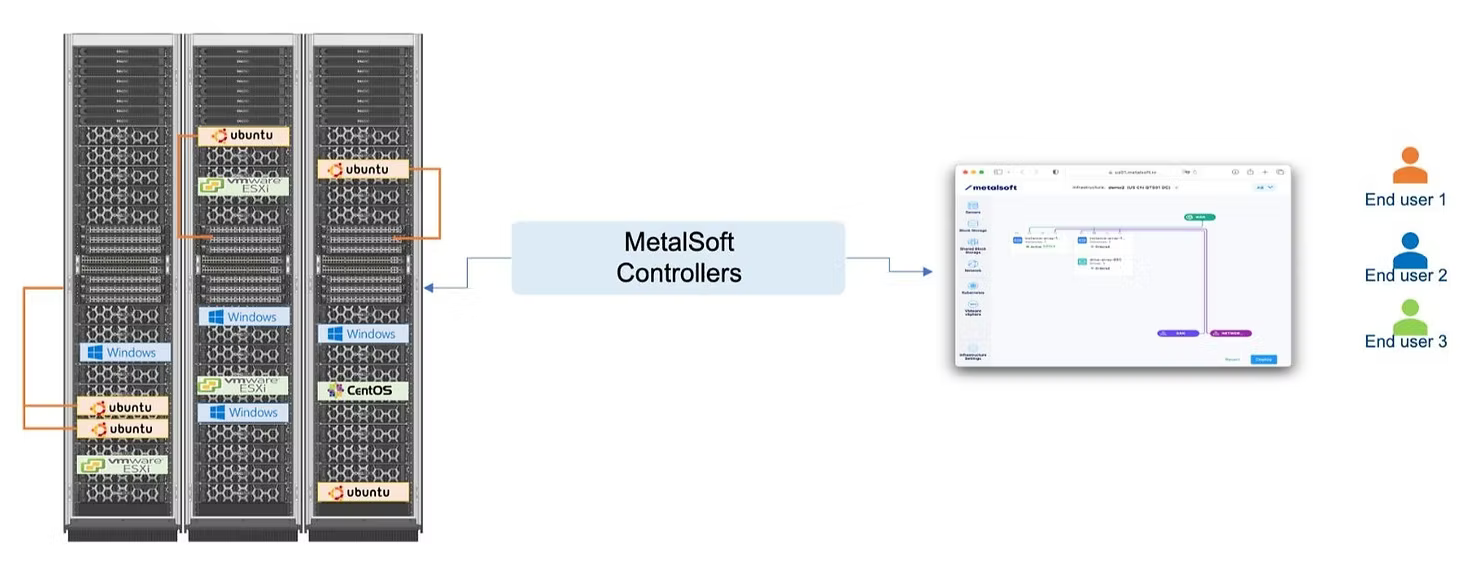
After physically installing infrastructure components (servers, switches, storage appliances) in a rack, MetalSoft controllers autonomously identify the hardware type and perform initial setup. This occurs without the need to install any agent on the hardware or any manual intervention, accomplished entirely through a Zero Touch Provisioning (ZTP) onboarding process.
End-users can then utilize a user-friendly GUI or APIs and begin consuming the infrastructure. For instance, if End User 1 requires five servers with Ubuntu OS installed, they can accomplish this with just a few clicks and within the security guardrails set up by network and server infra teams. MetalSoft platform will identify the right server configuration across the racks and make it available to the end user. If the use case additionally requires four servers to be part of a VLAN, MetalSoft platform will provision the required configuration on server OS and on the switch interface. Similarly, End User 2 may opt to deploy Windows OS on a different server, while End User 3 wants to create a Kubernetes cluster. The platform incorporates multi-tenancy, ensuring that each end-user has no visibility into others' infrastructure. When infrastructure is no longer required, end-users can decommission it, and MetalSoft will ensure all user data is wiped out and the infrastructure is restored to its default state.
Benefits
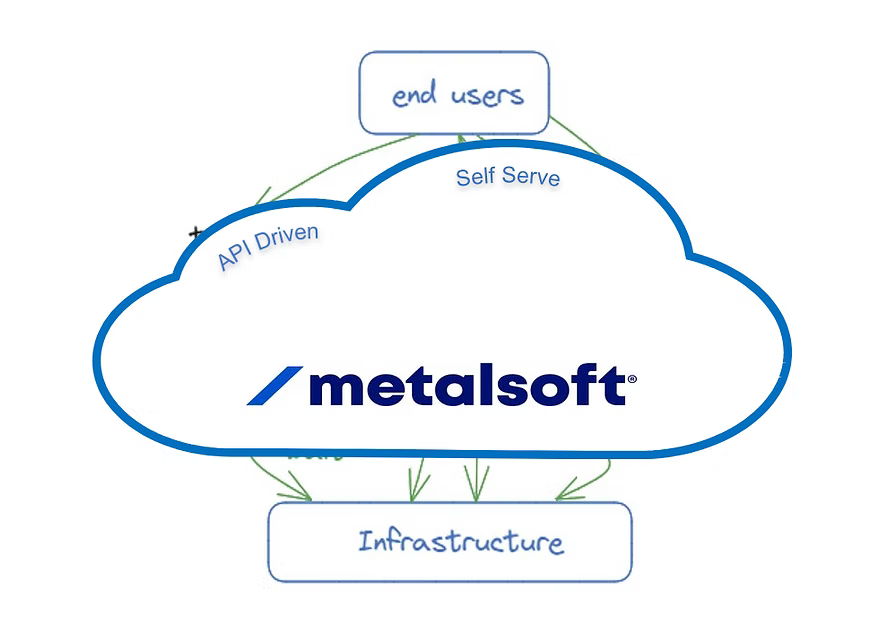
MetalSoft platform simplifies the uncooked spaghetti of today's infrastructure deployment to a soup-like easy consumption of the resources.
Key benefits of the platform include:
Time to value
MetalSoft platform drastically reduces the time required for infrastructure consumption, from months to mere minutes. It allows infrastructure teams to focus on value-added tasks as MetalSoft does the heavy lifting. Application developers and platform engineers can consume the infrastructure through a self-serve portal/API, bringing the operational efficiency gains of over 90%.
Unified Infrastructure Management Platform
MetalSoft's platform provides a centralized interface for managing infrastructure across multiple data centers and across servers, switches, storage, and applications. It is self-contained and needs no other component to operate, eliminating many third-party tools or bespoke scripts.
Automated Cluster and Application provisioning:
MetalSoft not only automates the provisioning and configuration of bare-metal servers and operating systems using predefined templates and but also provide workflow capability to extend the automation to virtualization, containerization and to application layers.
Policy based Lifecycle Management:
MetalSoft coordinates custom catalog-based firmware upgrades based on the deployed operating system, server type, and data center. Administrators can specify standardized configurations and policies, ensuring consistency and compliance across all deployments.
Automatic inventory and resource mobility:
MetalSoft provides an automatic, 100% accurate inventory view of individual infrastructure components ensuring higher hardware utilization and facilitating capacity planning. MetalSoft's ability to decommission existing infrastructure facilitates easy workloads mobility.
Scalability and Flexibility:
MetalSoft platform is designed to scale seamlessly across multiple data centers and edge locations. Administrators can dynamically provision and manage resources based on workload requirements, leveraging MetalSoft's automation capabilities to optimize resource utilization and minimize operational overhead.
APIs and Integrations:
MetalSoft exposes APIs and integrates with third-party systems, enabling enterprises to extend and customize its infrastructure automation workflows. This facilitates seamless integration with existing tools, processes, and workflows, ensuring interoperability and flexibility across the ecosystem.
By leveraging MetalSoft's unified infrastructure automation platform, enterprises can implement a cloud like infrastructure efficiently, reliably, and at scale.