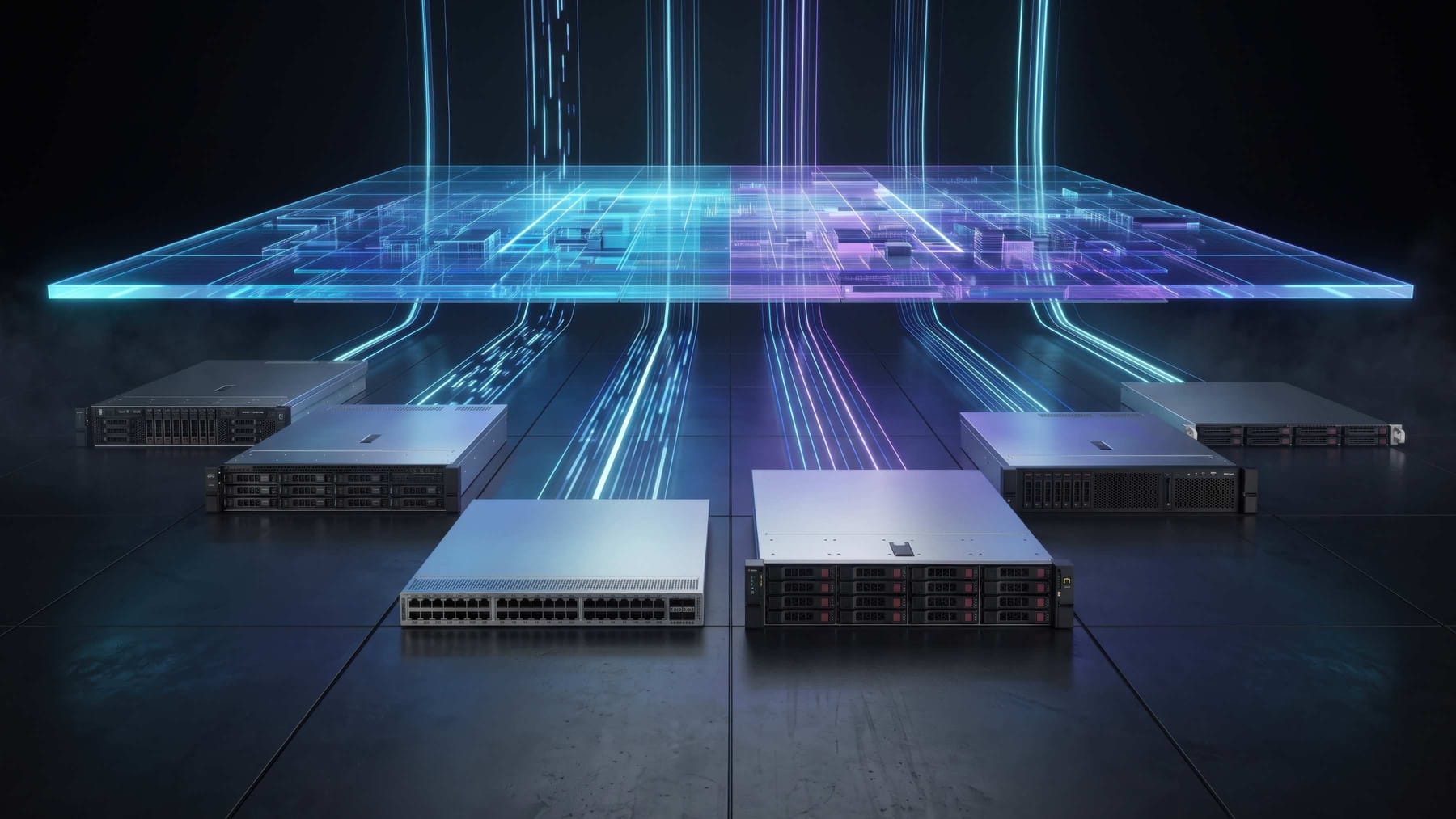
As semiconductor prices go stratospheric - DRAM prices being projected to surge by 125% alongside a 234% spike in NAND flash storage according to Gartner, and with no end in sight (Samsung estimates the crunch to last at least until 2028) - being locked into a single vendor is generating very high costs and delays for the enterprises running on-prem infrastructure. They cannot indirectly leverage the different supply chains that other vendors would have. Unfortunately, this lock-in is very common. Two in three companies we talk to say they standardize on a maximum of two vendors. This makes sense as each vendor has its own tooling, especially around lifecycle management, its own libraries for provisioning and its own plugins for monitoring solutions.
While in the US many companies resolve this by moving to the cloud, which removes the need to manage hardware (albeit expensively), European and, more recently, Canadian banks, telcos, and government institutions are looking to diversify and de-risk through vendor-agnostic orchestration.
This study, while AI-infrastructure-specific, does highlight the risks, calculating switching costs to typically range “from 2.3x to 5.7x the original implementation investment”.
In an enterprise stack, below the applications there are, of course, multiple layers, with the bottom-most being the hardware and the highest being IaaS or PaaS platforms such as the VM and container systems. Each has its own vendors. While I am looking at data center equipment in this article, I estimate the switching risks are about the same across the entire stack.
What exactly is “vendor abstraction” for data center equipment?
Many of the clients that we talk to bring “vendor abstraction” to the forefront of their requirements when looking for an infrastructure management solution such as MetalSoft, but what exactly does it mean?
As mentioned before, data center equipment is rarely used in isolation. It is usually plugged into monitoring systems and provisioning scripts and has staff that is often familiar with the respective vendor's supporting tooling and can perform lifecycle management.
Beyond staff skills, all of the technical integrations are usually developed in-house.
If a new vendor is to be introduced, these in-house developed and maintained integrations, often Ansible-based, while infinitely flexible, need to be updated for every vendor and potentially every generation of each system.
The degree of complexity and lock-in varies by equipment type, with the network vendor being the hardest (almost impossible) to change, with the staff training being the biggest hurdle.
An abstraction layer is therefore desirable to avoid the immense effort and costs associated with adding a new vendor. An abstraction layer would also provide the ability to remain state of the art, to quickly adopt technologies and remain “evergreen” instead of being stuck with 10-year-old technologies. This software layer would translate provisioning, monitoring, lifecycle into vendor-specific operations, presenting a common API and UI northbound.
Staff would learn to use the abstraction layer rather than each individual vendor's APIs just like application developers would be able to instantiate their containers on any Kubernetes cluster.
This is not a new concept, but implementing it in physical infrastructure has been difficult because of all the ancillary elements rather than the abstraction itself. What our clients typically ask for, beyond the ability to talk to the various hardware systems, is along the following lines:
- Self-service capabilities, CI/CD integrations, Terraform and Ansible
- Strict access controls
- OpenBao/Vault integrations for secrets management
- Unified logging with triage to various groups
- Rigorous auditing capabilities of every operation
- Extension and integration capabilities with IPAM, DNS and other systems like Infoblox and ServiceNow
- Unified monitoring capabilities, health checks and alerts
- Unified drift detection
- Unified lifecycle capabilities
MetalSoft is the only enterprise-level solution on the market today that solves this core challenge and provides, as Tom Fenton notes in this article, operational consistency and unified operations for heterogeneous hardware.
Adopting this approach and building a vendor abstraction layer promises to transform hardware management, from messy, manual work to disciplined, fast operations across multiple vendors, data centers and technologies.
Stay tuned.